
What is sentence
Table of Contents
What is sentence
A sentence is a group of words which makes a complete sense.
[ शब्दों का ऐसा समूह जिससे कि एक पूर्ण अर्थ निकलता है, वाक्य कहलाता है। ]
Examples:
(1) Birds fly in the air.
(2) Read this lesson carefully.
(3) What is your name ?
A sentence has two main parts – the ‘subject’ and the ‘predicate’.
The subject must contain a Noun or a Pronoun (Noun phrase) and the predicate must contain a Verb.
एक वाक्य में मुख्य दो भाग होते हैं— उद्देश्य (subject) और विधेय (predicate) । उद्देश्य या तो संज्ञा होता है या सर्वनाम (संज्ञा पद) तथा विधेय में क्रिया होती है।
उद्देश्य (Subject)—
वाक्य का वह भाग जो उस व्यक्ति या वस्तु को इंगित करे जिसके सम्बन्ध में हम बात कर रहे हैं, वाक्य का उद्देश्य कहलाता है।
● विधेय (Predicate) –
वह अंश या भाग जो उद्देश्य के सम्बन्ध में जानकारी देता है, वाक्य का विधेय कहलाता है।
Examples:
| Subject ( उद्देश्य) | Predicate ( विधेय ) |
| The boy
The sun He |
is playing now
Rises in the east Leaves for Bombay |
Usually a sentence consists of the following words in a certain order to make it meaningful.
Subject (कर्ता) –
वाक्य में निहित भाव या कर्म को सम्पादित करने वाला।
Doer or Actor of the sentence is called the subject
e.g., He, She, It, Ram, The ship etc.
A subject may be classified as –
(1) First Person (प्रथम पुरुष) –
One who speaks जो बोलता है। I, We
(2) Second Person (द्वितीय पुरुष) –
One who listens जो सुनता है।
You, All of you.
(3) Third Person (अन्य पुरुष) –
The person spoken about is called the third person.
जिस किसी के बारे में कहा जाता है। He, She, It, The boy, The sun, The train.
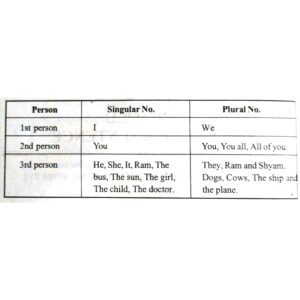
The above said persons may be either in singular number or in plural number.
The table shows the persons singular and plural wise
| Person | Singular No. | Plural No. |
| 1st person | I | We |
| 2nd person | You | You , You all , All of you. |
| 3rd person | He , she , it , Ram , The bus , The sun ,The girl , The child , The doctor. | They , Ram and Shyam , Dogs , Cows , The ship and the plane. |
The Verb (क्रिया)-
The word that denotes action which is done by in the sentence, is called the verb.
[ वाक्य में निहित कार्य को जो कि कर्ता के द्वारा किया जाता है, क्रिया कहते हैं। ]
The verb has two major parts:
(a) Main Verb (मुख्य क्रिया)-
It is found in the following forms:
(1) Present – go
(ii) Past – went
(iii) Past participle – gone
(iv) Present participle – going.
(b) Auxiliary Verb (सहायक क्रिया)-
am, is, are, was, were, have, has, had , do, does, did, shall, should, will, would, can, could, may, might, must, ought, need , dare, used to.
The Object (कर्म)-
It is a noun or pronoun which tells us the person or thing to whom the action of the verb happened.
(कर्म वह संज्ञा/ सर्वनाम है जिस पर कर्ता के कार्य का प्रभाव पड़ता है। )
Example:
He sells bicycles.
वाक्य में bicycles कर्म (object) है।
Parts of speech with examples , definition , types
Kinds of Sentence (वाक्य के प्रकार)
(1) Assertive Sentence (सामान्य कथन) –
इस प्रकार के वाक्य तथ्यों, वस्तुओं के बारे में वर्णन करते हैं। घटनाओं का विवरण बताते हैं।
Kinds of Assertive Sentence –
इनके दो प्रकार हैं
(A) Affirmative Sentence (सकारात्मक वाक्य) –
ये सकारात्मक कथन होते हैं।
Examples:
(1) He eats an apple daily.
(2) My mother usually cooks food.
(B) Negative Sentence (नकारात्मक वाक्य) –
वे कथन जो नकारात्मक भाव प्रकट करते हैं, negative sentence कहलाते हैं।
इनमें नकारात्मक शब्द no, not, none, never, seldom आदि का प्रयोग होता है।
Examples:
(1) We don’t make kites.
(2) He is not singing.
(3) Never tell lies.
(2) Interrogative Sentence (प्रश्नवाचक वाक्य) –
जिन वाक्यों से प्रश्नात्मकता का बोध हो, उन्हें प्रश्नवाचक वाक्य कहते हैं।
A sentence that asks a question is an interrogative sentence
Examples:
(1) Have you taken your lunch?
(2) Are you going to Agra ?
(3) Why are you singing now ?
(4) What is your name ?
( 3 ) Imperative Sentence (आज्ञा या प्रार्थनासूचक वाक्य) –
इस प्रकार के वाक्यों में आज्ञा या प्रार्थना या सुझाव आदि के भाव झलकते हैं। ये सदा क्रिया के मूल रूप से प्रारम्भ होते हैं।
Examples:
(1) Let’s start at once.
(2) Don’t go there.
(3) Help me
(4) Please, come here.
(4) Exclamatory Sentence (विस्मयादिबोधक वाक्य) –
ऐसे वाक्य जिससे आश्चर्य, प्रशंसा, न्दया या दुःख आदि का गहरा बोध होता है, मनोभावात्मक वाक्य कहलाते हैं।
इस प्रकार के वाक्य के अन्त में (!) (sign of exclamation) चिन्ह अवश्य लगाया जाता है।
Examples:
(1) What a wonderful piece of luck !
(2) How beautiful you are !
(3) What a fool you are !
(4) How clever my brother is !
(5) Bravo ! I ñave won the match !
(6) Alas ! We have lost a great friend.
(5) Optative Sentence (अभिलाषा सूचक वाक्य) or Wishes-
इस प्रकार के वाक्यों में किसी इच्छा का बोध होता है।
Examples:
(1) May God bless you.
(2) Many happy returns of the day.
(3) Be happy.
(4) May God bless this home.
(5) Wish you the best of luck.
Essay about india of my dreams